Technology use in K-12 schools is ubiquitous. Savvy school leaders no longer question tech relevance in the classroom. “That ship has sailed. The more important question is: Are we using technology purposefully?” said Dr. Melissa Shields, Assistant State Superintendent of Student Learning for the Alabama State Department of Education.
Data supports Dr. Shields' claim. The 2025-26 Project Tomorrow Speak Up research findings suggest that, when used effectively, technology tools, including AI, can transform the classroom learning experience and better prepare students. Nearly 100,000 K-12 students, educators, administrators, and families responded to the annual survey. Overwhelmingly, respondents felt current and emerging technologies are key to unlocking effective teaching and learning experiences to drive outcomes and provide students with durable, employable skills for college and career readiness.
During Project Tomorrow’s annual Congressional Briefing edLeader Panel, experts shared the latest findings, and four students served as panelists to provide feedback and recommendations for improving the classroom experience.
Parents and Students Want AI in the Classroom
48% of parents and families said students should learn to use AI appropriately and safely. When you think of durable, employable skills students need to learn, “parents are putting AI literacy and fluency in that bucket,” said Dr. Julie Evans, CEO of Project Tomorrow. 51% of respondents felt AI could help deepen understanding and answer questions when students are shy about asking in front of the whole class.
The student panelists agreed.
“When you get a job, you have to know how to use AI, not just look at AI," said Eloise, a seventh-grade student. She explained that her English teacher gave students AI-generated passages and taught them how to find sources and identify where AI made mistakes. “We were actually able to practice what we learned,” she said.
“I don’t think AI is dark. It’s just a tool. All it is is another computer algorithm compiling data. It can be wrong, and we need literacy to understand what’s happening behind the scenes and how it can be wrong,” said Tharun, a 12th-grade student.
The student panelists argued schools should teach how AI compiles answers, how sources are weighted, and why biases are ingrained in its responses.
The research also shows that AI use is mostly self-directed, Dr. Evans added. 46% of students said they are learning about AI on their own; only 30% said they are learning in class. 40% of high school students use AI as a study guide or assistant weekly, compared to only one-quarter last year.
Students Want to Solve Problems
Approximately 93% of hiring managers said critical thinking is the most important skill for job candidates, and 90% said they are more likely to hire someone who can reliably solve problems, Dr. Evans shared. Preparing students for the future requires classrooms to better support independent thinking, active learning, and teamwork.
The student panelists recommended schools incorporate more project-based learning. Giving students opportunities to tackle local issues and apply what they learn inspires more engagement.
“It makes you want to learn,” said Jordan, an 11th-grade student. He described a project-based learning exercise in geometry where he used tools like Google Earth and ChatGPT to redesign a school courtyard to scale. Translating what you’ve learned to the real world builds leadership skills and “helps you communicate and articulate your ideas,” he said.
Project-based learning also involves teamwork, a skill students recognize as essential for a future workplace. Kennedy, an eighth-grade student, acknowledged how important Associated Student Body (ASB) has been in helping her learn to collaborate, because “getting into new opportunities, you need to be able to work with others,” she said.
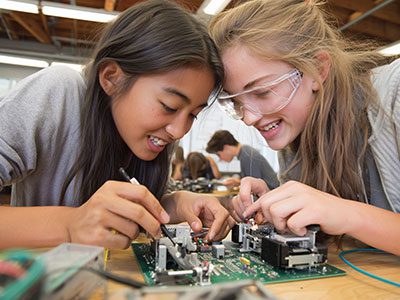
Tharun mentioned labs are a great way to bridge passive learning and active learning. “In labs, you do things you just can’t Google. You can use Google to find formulas and laws, but you have to think and apply these skills, and it comes back to that critical thinking,” he explained.
How To Begin
Preparing students for the future requires leaders with open minds to ask questions and hear perspectives that challenge assumptions, because “ultimately, meaningful innovation begins with meaningful listening,” Dr. Shields said.
What are the outcomes from the effective use of technology for students, teachers, and families that matter the most in 2026? Watch the recorded Congressional Briefing edLeader Panel for more research insights.
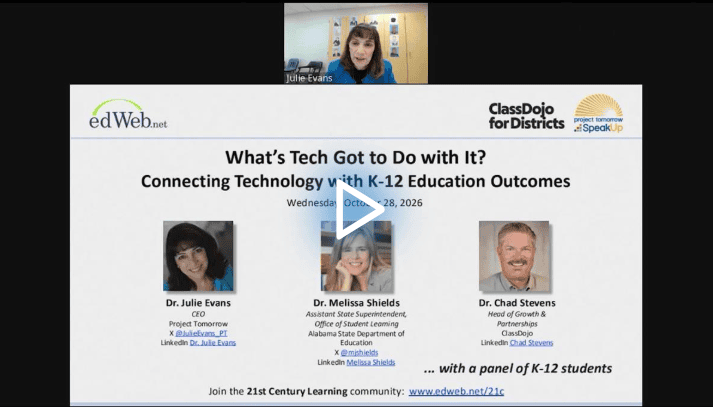
Learn more about this edWeb broadcast, What’s Tech Got to Do with It? Connecting Technology with K-12 Education Outcomes, hosted by Project Tomorrow and sponsored by ClassDojo for Districts.
Join the Community
21st Century Learning is a free professional learning community that serves as a forum for collaboration in a world where change is constant and learning never stops.

ClassDojo is on a mission to give every child an education they love. Used in 95% of U.S. schools, ClassDojo helps teachers and families build stronger school communities through everyday communication. ClassDojo for Districts is a unified communication and engagement platform that brings everyday classroom updates and districtwide messaging into one seamless experience. Families feel connected, students stay engaged, and school culture grows stronger. It's built with privacy at its core and available to districts at no additional cost. Learn more at www.classdojo.com/districts.

Project Tomorrow is a national nonprofit organization with a mission to ensure that today’s students are well-prepared to become tomorrow’s leaders, innovators, and engaged citizens of the world. We support that mission with programs and research that focus on innovation and new learning models in the K-12 classroom, including through the effective use of technology.


Article by Suzanne Bell, based on this edLeader Panel