Too often, English Learner (EL) instruction is taught in isolation, especially when it comes to the content. Students are pulled out of class or scheduled for additional instruction, but the topics of the vocabulary, spelling lists, and grammar exercises bear no resemblance to the content in their core classrooms. Moreover, because the student is an EL, expectations are often lowered, and the student receives less rigorous texts in their main classwork.
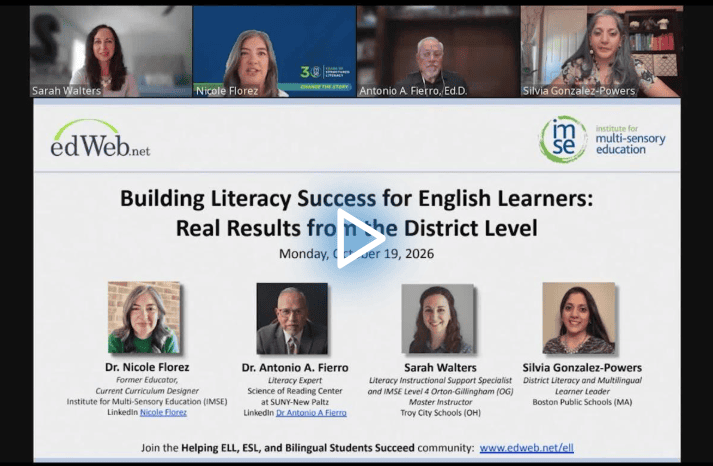
In the edLeader Panel "Building Literacy Success for English Learners: Real Results from the District Level," educators and experts explained why Tier 1 instruction and EL lessons should work in concert and gave strategies for successful implementation.
First, if the goal of EL instruction is to develop proficiency in English so students can confidently participate in mainstream work, then othering them works in antithesis to the goal. Students might learn the parts of a sentence or the meaning of basic words, but they won’t be able to participate in meaningful classroom discussions or advance with their fellow students. Moreover, when they aren’t given methods for approaching more complex texts, they aren’t given opportunities to improve their skills.
Second, if the EL and core classroom teachers prepare lessons with no cohesion—even if they meet to discuss student progress—they aren’t working towards a unified progression. EL students need support from all of their teachers in order to become proficient, and that support needs to be in sync. Otherwise, they could get conflicting messages about how to improve their skills.
Finally, teaching language is about form and function. Morphemes, syntax, etc., which are about how to form the language, are essential, but students also need to be able to express themselves in the language. They need to be able to make observations, create descriptions, participate in debates, and overall use the new language to communicate in a variety of forms. Knowing how to spell a word or find the subject in a sentence doesn’t help if the student can’t use the language to convey their ideas.
Implementation Strategies
EL lesson content should support core instruction. If the ELA class is reading a specific novel, then the EL teacher should help them work through the vocabulary and themes ahead of time, allowing the student to participate in class discussions. When the science teacher plans a new unit, the EL teacher should prepare the student for the terminology and assignments. The EL lessons can still contain the same components (studying phonics, morphemes, syntax, semantics, etc.), but the content should specifically set students up for success with their core classwork.
Respect the student's knowledge. Both EL and core curriculum teachers should include opportunities for students to bring their own experiences into the classroom. By encouraging them to explain their own background and ideas, teachers help students connect the new language to the real world.
Maintain rigor and expectations. While EL students might need scaffolding to help them achieve grade-level standards, teachers should assign them the same texts as the rest of the class. After all, as they work towards proficiency, the students should be on the same level as their peers.
Hire EL experts. Teaching EL students requires specialized knowledge. Schools should have EL coaches on staff who can not only develop the program but guide the staff on how to help students at every level.
Provide continuous professional development. Since all teachers are responsible for helping EL students, all teachers need training. But it shouldn’t be limited to one or two workshops a year. Instead, schools should form cohorts so teachers can work together on best practices, guided by the EL coaches. This can include regular meetings, classroom observations, and formal sessions.
Start small. If you don’t have a comprehensive program, don’t try to build it all at once. Begin with creating small teacher groups who can provide each other with feedback or focus on a specific grade level. Figure out what works best for your school and develop from there. As always, use data to inform what practices are impacting students the most.
Most important, treat every lesson as an opportunity for language development. Students use language at every point in each classroom, whether explaining how they solved a math problem or writing an essay. These are all moments where a teacher can step in and make sure that the student is developing their skills, and the other students in the classroom will benefit from building their proficiency as well.
Learn more about this edWeb broadcast, Building Literacy Success for English Learners: Real Results from the District Level, sponsored by The Institute for Multi-Sensory Education (IMSE).
Join the Community
Helping ELL, ESL, and Bilingual Students Succeed is a free professional learning community that focuses on helping students to improve their learning and language ability.

The Institute for Multi-Sensory Education (IMSE) offers Structured Literacy curricula and professional learning based on the Orton-Gillingham approach. IMSE’s training and resources help educators learn to teach reading the right way and improve reading proficiency across all student levels. The focus areas include phonological awareness, morphology, and direct, explicit instruction tailored to meet diverse learning needs. IMSE’s programs are designed to align with the latest research in the Science of Reading, supporting equitable literacy education in classrooms nationwide.

Article by Stacey Pusey, based on this edLeader Panel