Chronic absenteeism is a serious problem that causes students to fall dramatically behind in school, creating gaps that may never close. How can educators identify its signs and get families involved before it’s too late?
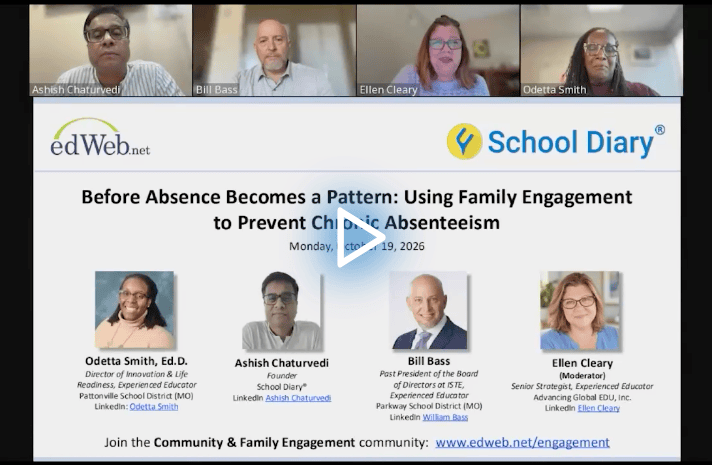
During the edLeader Panel "Before Absence Becomes a Pattern: Using Family Engagement to Prevent Chronic Absenteeism," Ellen Cleary, Senior Strategist at Advancing Global EDU, led a conversation about this critical issue with Dr. Odetta Smith, Director of Innovation and Life Readiness for the Pattonville School District (MO), Ashish Chaturvedi, founder of School Diary, and Bill Bass, Innovation Coordinator for Instructional Technology, Information, Library Media, and Federal Programs in the Parkway School District (MO), and Past President of the Board of Directors at ISTE.
Chronic Absenteeism Defined
Chronic absenteeism is when a student misses about 18 school days for any reason. It not only negatively impacts students’ learning but also diverts teachers’ time away from educating to reaching out to families.
This is not a simple problem; it has many causes, such as changes at home, language and access barriers, health issues, transportation problems, and others. Data regarding the causes can be difficult to gather, as it’s often siloed across various departments, which causes even more problems—there is a cost to waiting to address chronic absenteeism.
Students become less proficient in reading and math, grades drop, and the risk of dropping out rises. Affected students often feel trapped and don’t believe they can catch up, increasing the chances of absence.
The CUE Framework
Unfortunately, there is no instant fix for chronic absenteeism—managing it requires constant work. However, the panelists shared how the CUE Framework can be used to effectively address chronic absenteeism through three areas: Catch, Understand, and Engage.
Catch
Before absenteeism becomes chronic, there are patterns that appear, which, if caught, can be addressed early. Students at risk of chronic absenteeism miss specific days, such as the same day every week, days before holidays or long weekends, or test days, often in the same subject. Absences repeat, but can be missed because an individual week or two looks okay. It’s only when looking at longer time spans that the issue becomes apparent.
Understand
Once patterns are found, look for reasons, such as frequently late buses or changes at home. Once a pattern is identified, schools must reach out to families to see what kind of support they need. However, families can sometimes be hard to reach, and multiple teachers and staff reaching out can be overwhelming. This is where the third area comes into play.
Engage
The school’s type of outreach should match the pattern of absences. When a pattern first appears, the attendance office posts a short, friendly note to the parents or caregivers. Should the pattern persist, teachers or attendance staff reach out with a message inviting responses. If the pattern is deep or tied to a student’s needs, then the MTSS or student support team reaches out with a counselor, nurse, or family liaison, and an interpreter, if needed.
Addressing the Barriers
As with most things, there are barriers to family engagement; however, there are tools that can help. Systems such as SIS (student information system) apps have ways to ease communication, such as providing translations for families that don’t speak English. Additionally, many parents or caregivers prefer speaking with someone over reading. Apps allow them to communicate in their preferred language, rather than receiving notifications with no opportunities for discussion.
Remember that families may not be able to attend after-school events. Districts must find other ways to communicate with families, and in the languages they’re comfortable speaking. Systems such as School Diary automatically track student attendance, flagging patterns and predicting absences, taking some work off teachers.
Programs prioritize at-risk students, allowing staff to log reasons for absences and identify parents or caregivers who haven't engaged. Additionally, such systems are multilingual, allowing teachers to better reach families that speak other languages and provide private, two-way communication.
Chronic absenteeism is a problem with no simple solution; therefore, it’s always best to identify the signs as they emerge and act quickly. By finding efficient ways to work with families, schools can intervene to help students get the full education they deserve.
Learn more about this edWeb broadcast, Before Absence Becomes a Pattern: Using Family Engagement to Prevent Chronic Absenteeism, sponsored by School Diary®
Join the Community
Community & Family Engagement is a free professional learning community where district and school administrators, teachers, counselors, support staff, and all educators can connect and share ideas, practices, and resources to support students and families and engage the community in helping students learn and thrive.

School Diary is an education technology platform helping schools and districts build stronger connections between students, families, educators, and school communities. Designed for K–12 education, School Diary brings critical student information and communication into one connected platform, helping school leaders move from fragmented data to timely action.
Schools can use School Diary to connect attendance, academic performance, behavior, health, and family engagement signals to better understand student needs and identify emerging patterns early. Its communication tools support two-way, multilingual engagement across 200+ languages, helping schools reach families in the language they prefer and build stronger partnerships around student success.
School Diary is built around a simple goal: help schools keep every student connected, supported, and engaged in learning. By combining actionable student insights with meaningful family engagement, School Diary helps educators address challenges earlier and create the conditions for stronger attendance, participation, and outcomes.

Article by Jon Scanlon, based on this edLeader Panel