


edWeb.net and myON today announced a combined effort to provide educators with robust professional learning opportunities to transform literacy for all pre-K–12 students. myON will sponsor the professional learning community “Building a Community of Readers” on edWeb.net as a forum for professional learning and collaboration focused on all aspects of literacy. Educators will be able to collaborate online across the country and around the world to leverage information and learn best practices from their peers to build innovative approaches to literacy for the classroom.
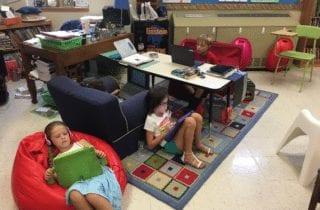
More than 10 million American students struggle to read, but only 2.3 million are identified and even fewer receive special help; schools must provide support for struggling students by creating a culture of reading. In “45 Ways to Support Struggling Readers: A School-Wide Approach,” hosted by edWeb.net and sponsored by Learning Ally, Terrie Noland, Learning Ally National Director, Educator Engagement; and Kristy Mathieu, Kiker Elementary, Austin, TX, presented tips for how schools can support struggling readers.

School leaders can use online networks and communities for their own personal professional learning, and to support collaboration with staff across schools and districts. In “How Online Learning Communities Help Principals Collaborate and Succeed,” Shannon Holden, Assistant Principal, Republic Middle School, MO, presented on the unique possibilities that online collaboration offers for personal professional learning and within schools, and how school leaders can use edWeb.net for online collaboration with staff.

Communicating can be a challenge for certain individuals with autism. In “Communication Innovations for Individuals with Autism,” Howard C. Shane, Ph.D., CCC-SLP, Associate Professor at Harvard Medical School and Director of the Center for Communication Enhancement and the Autism Language Program at Boston Children’s Hospital, discussed different types of communication displays, explained the Visual Immersion System™ (VIS), and talked about repurposing consumer products to provide Just In Time Communication to individuals with autism.

It is important to define and address literacy problems to ensure that struggling students learn and improve. In “Teaching Students with Literacy Problems—Including Dyslexia,” hosted by edWeb.net and sponsored by Brookes Publishing, Nickola Wolf Nelson, Ph.D., Professor Emerita, Department of Speech, Language, and Hearing Sciences, Western Michigan University, reviewed techniques educators can use to teach their students with literacy problems.
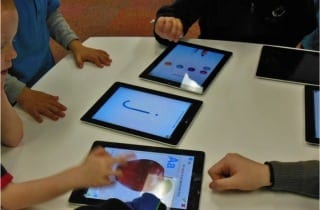
Change is inevitable, and while it’s important to design lessons with an end result in mind, it’s difficult to prepare students for a future that doesn’t exist yet. In the recent edWebinar, “The Future Ready Challenge: Improve Student Outcomes in 18 Weeks,” hosted by edWeb.net, Dr. L. Robert Furman, Elementary Principal and author of The Future Ready Challenge, discussed tips to help educators prepare students for an unknown future.

ORIGO Education is offering a live stream education seminar, Making the Most of Math Models, May 10 at 3:00 p.m. EDT on edWeb.net. The edWebinar will help teachers use meaningful visual and concrete math models to support coherent content progressions in mathematics across grade levels. ORIGO president and co-founder, James Burnett, will introduce four visual models often used in grades Pre-K–6 and lead a discussion about the benefits of using the array/area model for developing multiplication facts. He will also show how the thinking can be extended through grade levels.

edWeb is so excited to congratulate Michelle Luhtala, department chair at New Canaan High School Library in Connecticut, for being selected as a 2017 AASL Social Media Superstars winner! AASL’s Social Media Superstars program honors school library professionals who enrich the profession and its work on behalf of students by sharing information, expertise, ideas, encouragement, dialog and inspiration using a variety of social media channels.

edWeb.net and Abrams Learning Trends are working together to launch a professional learning community, Be a Literacy Hero in the K-5 Classroom, to support K-5 teachers with practical tips, expert guidance, and instructional best practices designed to help teachers have an immediate impact with their students in the classroom.

edWeb.net and MeTEOR Education announce the launch of the free professional learning community on edWeb.net to help educators at all levels create high-impact learning environments and experiences for their students. Linda Dove, M.Ed., and Director of Learning Experiences at MeTEOR Education, presented an opening edWebinar on April 3rd to launch the program to an audience of over 300 educators from around the country and the world. She presented research that shows the impact of effective learning environments on student performance. Educators were highly engaged during the program and had lots of questions about how to design effective environments that encourage students to take risks, work for special needs students, and help to manage disruptive behaviors. They wanted suggestions on how to afford creating new environments when resources are limited.