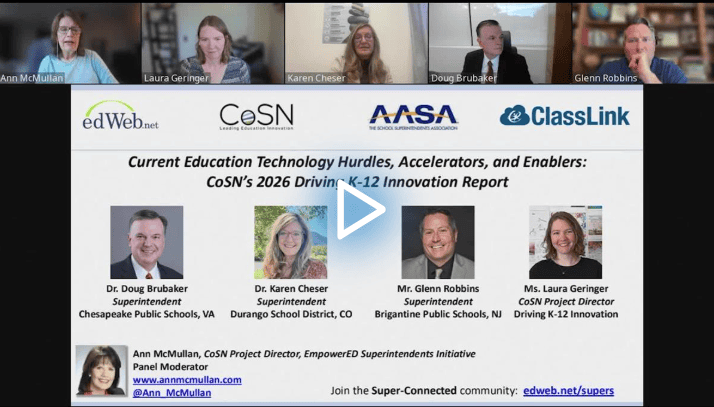
This edLeader Panel is presented by CoSN and AASA.
Sponsored by ClassLink
How students demonstrate learning tops one of the mega-trends facing leaders this year. So does empowering students to choose what and how they learn. CoSN’s annual Driving K-12 Innovation Report names the three top hurdles, accelerators, and technology enablers—obstacles, mega-trends, and tools—identified by 130 educators and technology experts.
The recent edLeader Panel, "Current Education Technology Hurdles, Accelerators, and Enablers: CoSN’s 2026 Driving K-12 Innovation Report," provided an overview of the 2026 report as superintendent panelists shared how it all played out in their school districts. What’s next in education? Let’s dive in.
3 Mega-Trends Shaping Education
1. Building Better Leaders
Turnover takes its toll, and institutional knowledge gets lost. As new, younger leaders rise to the challenge, building human capacity for leadership returns to the trends list for the fifth year in a row, and districts are getting creative. In Durango, Colorado, administrators created a leadership competency portrait that guides training and hiring decisions. The traits reflect the soft skills expected of students, including being “agile thinkers, empathetic collaborators, and creative problem solvers,” explained Dr. Karen Cheser, Superintendent of the Durango School District.
In New Jersey, a proactive look at data helps administrators consider what can be done better so “each person feels empowered to give experiences or memories for a kid they may have never had,” said Glenn Robbins, Superintendent of the Brigantine Public School District.
2. Rethinking How Students Show What They Know
As technology evolves and students become more savvy, leaders are rethinking gold standards for how students demonstrate learning. By tapping into student agency and tech skills, students can hone real-world business skills such as presentations and video editing to amplify what they learn. “It has to be active and has to be about creation, having kids develop their own products that show their mastery and skills,” said Dr. Doug Brubaker, Superintendent of Chesapeake Public Schools in Virginia.
3. Giving Students Voice and Choice
The alpha generation, our current students, expect to be part of planning for education. Students want to have options and flexibility in what they learn. “A lot of our programs have come from student ideas,” said Robbins. Student ideas launched school podcasts, TV studios, robotics teams, AI use, and more. Dr. Cheser described an Ignite Mobile Learning Lab, a STEM bus designed and promoted by students and brought to the community. The more students can be part of the solution, the more schools can create places that inspire.
3 Trends Holding Schools Back
Now more than ever, schools face tough challenges, and this trio tops the list.
1. Keeping the Best Teachers and Staff
Attracting and retaining good people remains a constant challenge. Districts offer competitive salaries and provide more opportunities to grow and learn. However, district leaders in Durango have taken an extra step—they purchased an apartment complex for workforce housing to address the largest expense for their teachers and staff.
For most districts, the panelists recommended looking closely at fit and fostering an environment that makes people want to stay. They even said that it’s almost better to leave a position empty than to fill it with someone who may not embrace what it means to work in education.
2. Ensuring Security and Safety Online
Phishing emails and hacking attempts are ever present and getting trickier—a constant whack-a-mole, according to the panelists. If someone gets access and “changes an ACH number, it could mean hundreds of thousands of dollars lost by a district,” warned Dr. Brubaker. Ongoing training for staff, families, students, and teachers helps counter bad actors and reduce mistakes. The panelists recommended balancing student safety without overburdening tech access for instruction.
3. Teaching What’s Real and Not Real
Media literacy is paramount. With the rise of AI-generated content, students, teachers, and families need tools and knowledge for assessing what's reliable, factual, and real. Leaders can take charge by offering introductions to AI, providing digital literacy education (for example, using lessons offered by Common Sense Media), and having deep conversations about what is ethical and what is not.
Learn more about the intersections between trends and solutions and which top three tech tools help the most by downloading the report or watching the full edLeader Panel.
Learn more about this edWeb broadcast, Current Education Technology Hurdles, Accelerators, and Enablers: CoSN’s 2026 Driving K-12 Innovation Report, presented by CoSN and AASA and sponsored by ClassLink.
Join the Community
Super-Connected is a free professional learning community for school superintendents, district leadership, and aspiring district leaders.
AASA is the premier association for school system leaders and serves as the national voice for public education and district leadership on Capitol Hill.

CoSN (the Consortium for School Networking) is the premier professional association for school system technology leaders. CoSN provides thought leadership resources, community, best practices and advocacy tools to help leaders succeed in the digital transformation. CoSN represents over 13 million students in school districts nationwide and continues to grow as a powerful and influential voice in K-12 education.
ClassLink is the identity and access management platform trusted by over 25 million students and staff in more than 3,000 school systems worldwide. ClassLink simplifies access with single sign-on, automates provisioning and rostering, and strengthens security and governance across the school system. With analytics that connect edtech usage to student outcomes, ClassLink helps education leaders manage technology with confidence and invest in what works. Learn more at classlink.com.

Article by Suzanne Bell, based on this edLeader Panel