
It’s tempting to create a new program or purchase a new tool when federal school improvement funding is available and must be accessed fast. Nobody wants to lose out on those valuable dollars.
But a “quick fix” without a clear vision can backfire: limited buy-in, no impact, ultimately unsustainable. And all that funding wasted.
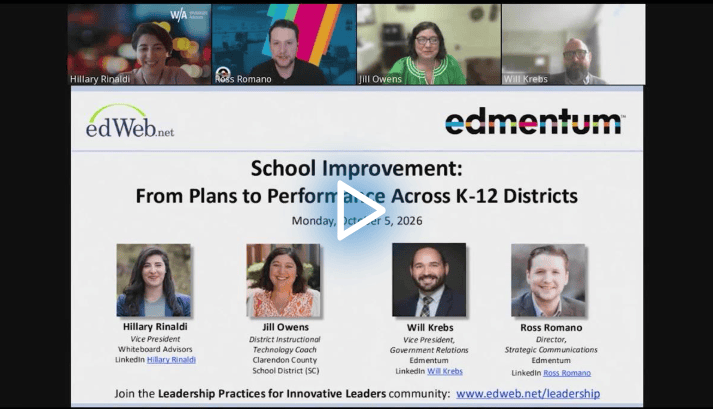
What matters most is allocating the money with a purpose and driving meaningful local results. Education leaders and experts in the edLeader Panel “School Improvement: From Plans to Performance Across K-12 Districts” outlined practical steps for doing this work.
Funding: A Primer
Every fall, states designate new low-performing schools, opening eligibility for federal dollars, including Title I School Improvement funds. It’s critical to understand the funding process to develop and fund appropriate programs.
Designations: A designation is the start of the funding flow, beginning with comprehensive support for the bottom 5% of schools. Targeted support is for student subgroups; additional in-school support can also be available.
Funding Types: Designated schools receive improvement funds that states set aside, with comprehensive support schools funded first and at a higher amount. These can be meshed with general Title I and Title II funds for purposes from educator coaching and professional learning to career technical education.
Decision Making: Federal law sets out the process for identifying schools and allocating resources. The state determines the measures of school quality and student success and sets the amount each designated school receives. Districts set out school improvement plans and decide how to braid support for all schools’ needs.
Blending and Braiding Funds: Blending puts all the money in one bank account and lets the district write checks freely. Braiding keeps the funds separate for reporting and accounting.
The plan drives the money. What is in the district improvement plan gets funded. Selected tools and programs must be part of that plan; funding is the means of achieving it.
Steps Toward Success
To drive improvement within funding and organizational parameters—and to put success at the forefront—strategy is key. The following recommended steps can guide successful program design and implementation.
Frame and Communicate the Goal
Before planning or naming a solution, use data to identify student needs—or the “why”—and decide what can realistically be supported. Consider: Can the solution be implemented? Can teachers receive professional learning? What will indicate students are learning?
Build the Plan
With the need targeted, establish corresponding outcomes and strategies to meet them. When everybody understands the “why,” sees how it connects to student needs, and knows their role within it, it’s much easier to move from plan to meaningful implementation.
Sustainability should be top of mind: An effort should be steady over a few years rather than a one-off. Consider a common approach across schools with similar needs, with flexibility, fidelity, and consistency in mind.
Fund the Plan
Treat all sources as a single pool and match each cost to the appropriate source. Pay attention to timelines, as school and fiscal years overlap, and bring in budget staff to assist. Identify what the funds are meant to do: Build capacity? Staffing? Support ongoing costs? Spreading funds thinly is a mistake. Concentrate where need is greatest, and staff is ready.
Select Solutions
Diagnose the problem before buying anything. Choose evidence-based tools that align with core instruction and avoid running too many initiatives at once. And plan to “meet” the evidence tiers in the Every Student Succeeds Act (ESSA): Tier 1: The randomized controlled trial (RCT); Tier 2: moderate evidence from a quasi-experimental study; and Tier 3: promising evidence showing a positive relationship between an intervention and student outcomes.
Monitor and Course Correct
Plan from the start how to measure results. Track leading and lagging indicators, asking, “Are we on track? What is and is not working?” Be prepared to adjust the measures and parameters. Finally, check results against the plan and the spending: Are they in sync?
Celebrate
When results are achieved, celebrate the indicators that say you are on track, student gains, and the growing willingness of students and teachers to jump on board.
Learn more about this edWeb broadcast, School Improvement: From Plans to Performance Across K-12 Districts, sponsored by Edmentum.
Join the Community
Leadership Practices for Innovative Leaders is a free professional learning community where school and district leaders share and collaborate on personal leadership skills, professional learning and support for teachers and staff, student learning and well-being, communication with all stakeholders, and more.

Edmentum believes that every student deserves the opportunity to thrive everywhere learning occurs—whether they seek to catch up, stay on track, or chart their own path. When you pair Edmentum’s comprehensive, research-backed learning acceleration solutions—including digital curriculum and courses, K-12 diagnostic-driven personalized intervention, and virtual instruction—with empowered and supported educators, you can change the direction of students’ lives. We partner with K-12 educators in all 50 states and 100+ countries worldwide to design, implement, and sustain the programs that deliver on this shared promise of learning acceleration for every student.

Article by Michele Israel, based on this edLeader Panel