
Children’s education neither begins nor ends in the classroom. Families play a vital role in the learning process, but might not know how to best support their children, and educators often aren’t sure how to help families provide support.
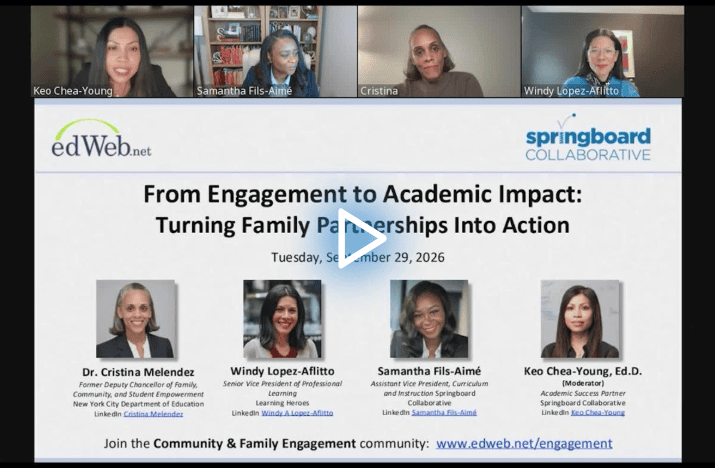
Throughout the edLeader Panel "From Engagement to Academic Impact: Turning Family Partnerships Into Action," Dr. Cristina Melendez, former Deputy Chancellor of Family, Community, and Student Empowerment at the New York City Department of Education, Windy Lopez-Aflitto, Senior Vice President of Professional Learning at Learning Heroes, and Samantha Fils-Aimé, Assistant Vice President of Curriculum and Instruction at Springboard Collaborative, shared how educators can build partnerships with families to better support students. The conversation was moderated by Dr. Keo Chea-Young, Academic Success Partner at Springboard Collaborative.
4 Distinguishing Factors
Schools with strong family engagement have greater attendance numbers, fewer chronically absent students, and more students meeting ELA and math proficiency standards. Additionally, schools that focus on strong family engagement can mitigate some of poverty’s effects on student outcomes. These schools typically have four distinguishing factors:
1. They see families as equal partners.
2. Their leadership has a clear vision, expectations, and infrastructure.
3. Their teachers have academically focused, one-on-one, unwavering communication with families.
4. There are personal and enduring relationships between teachers and families.
Families Want to Help, But Often Don’t Know How
Families often rely on grades to determine if their child is at or above grade level, with those who know that their child is below proficiency being more likely to act. Families want to help, but often don’t know how. They want to know what tools are available and how to support learning at home.
Partnerships between families and teachers grow and last when they begin seeing families as people they work with to support students. It's essential to recognize that families can help and provide opportunities to do so.
One way to do this is by building intentional questions into every interaction. Asking for information on their child positions families as experts and helps them feel acknowledged, building a foundation of trust. Teachers can also create these opportunities, for example, by asking families what they need in order to be actively engaged. And, when discussing academics with families, incorporate strategies to use at home. Providing actionable strategies helps build buy-in.
Systemic design often limits opportunities for teacher-family partnerships. Those systems must be challenged so that schools can bring families in to help create a system of shared responsibility, where families know what their children are learning and how to support it. Familial support also goes a long way towards giving students the confidence they need to be ready to learn.
Schools must let families provide input regarding what they need to support their children’s learning, act on that input, and communicate how they did so. This is a lot of work on top of everything else teachers have on their plates, so it’s crucial that leadership supports them in this.
Family Enablement
Family Enablement, the process of building families’ abilities to take meaningful action to support learning, is critical. Schools need to intentionally build families’ knowledge, confidence, capacity, and agency by designing experiences that allow a partnership between teachers and families to grow. By giving teachers support and professional development, leadership helps them see what they need to do to build and sustain authentic partnerships.
From there, schools must center families in learning structures in order to promote shared responsibility, trust, and engagement. Additionally, teachers need to cultivate trusting relationships via clear, consistent, respectful, two-way communication. And, don't forget to ensure families can understand their students' data so they know what their children need.
Building partnerships with families gives students the support they need both at school and at home. Communicate with families to find spaces where they can provide input and identify what they need to be able to help their children at home. When teachers and families come together, students have what they need to succeed.
Learn more about this edWeb broadcast, From Engagement to Academic Impact: Turning Family Partnerships Into Action, sponsored by Springboard Collaborative.
Join the Community
Community & Family Engagement is a free professional learning community where district and school administrators, teachers, counselors, support staff, and all educators can connect and share ideas, practices, and resources to support students and families and engage the community in helping students learn and thrive.

Springboard works with districts to accelerate learning for the students who need it most. Every program is built around family-educator partnership: families are activated as members of the teaching team, not invited as observers. In literacy, that model produces an average of five months of learning gains in as few as seven weeks, with family participation exceeding 89% nationwide.

Article by Jon Scanlon, based on this edLeader Panel