Despite heavy district investments and stronger curricula, students across the country continue to struggle with math. A common reason is that they lack math fact automaticity, causing them to divert focus to math processes they should be able to complete without thinking. So how can schools address this?
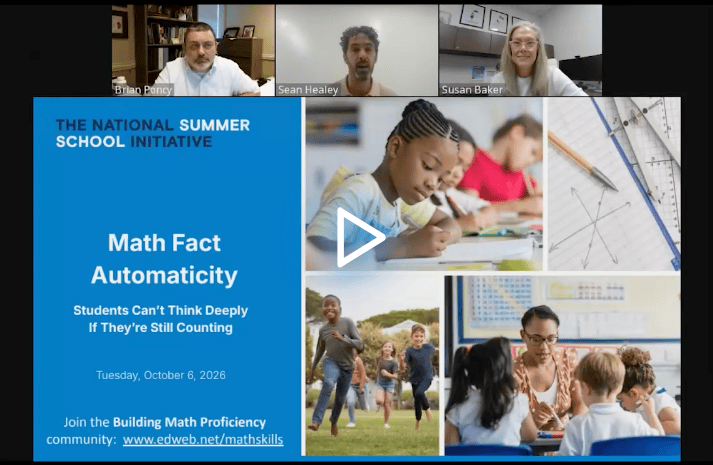
Throughout the edLeader Panel "Math Fact Automaticity: Students Can’t Think Deeply If They’re Still Counting," Dr. Brian Poncy, Professor and Director for the School Psychology Program at Oklahoma State University, Susan Baker, Director of Mathematics for Fulton County Schools (GA), and Sean Healey, NSSI Mentor Teacher and Director of Schools at KIPP SoCal, discussed the importance of math fact automaticity, how it connects to conceptual understanding, and what leaders can do to build automaticity in their districts.
The Problem
Schools aren’t seeing needed improvements in math outcomes, despite investing in curricula, professional learning, and other tools and support, because their core curricula focus on procedural fluency and conceptual understanding while constantly moving forward. There’s no time for fluency and automaticity. Instead, students learn procedures and build on them, giving learners more work without providing the necessary tools to automatically access facts. Teacher practices must shift the focus to students showing their thinking and giving them time to develop the fluency needed for automaticity.
Foundational Skills
Foundational skills are crucial for mathematics success. Those skills help students develop a working memory of basic facts, which grows their understanding. Gaps in foundational math fact skills are detrimental across all grade levels, with no lasting way to bridge them. Students need a working memory of math facts they can automatically use to solve problems and build on prior knowledge.
Conceptual Understanding
Also essential to math fact automaticity is conceptual understanding. Students must be able to recall the basics in order to move on to the next skill. After all, mastery starts with understanding the basics—the foundation of higher concepts, helping students turn concepts into facts. As students demonstrate mastery of skills, the procedures used for those skills become automatic.
Effective Practices for Automaticity
The panelists shared some guidelines for teachers for effective practices that focus on developing automaticity:
- Build up from the basics and introduce math facts one at a time, interweaving them with previous material.
- Practice should be short in duration, after students have a conceptual understanding of the material.
- Begin with basic work before introducing timed practice, once teachers are satisfied with students’ accuracy.
- Include repetition of past concepts, aiding memorization. Just moving on to new material results in students forgetting prior lessons.
To ensure automaticity, teachers must be thoughtful about curriculum development and interweave lessons, building on and connecting material. Teachers can build engagement by letting students track their own progress. Learners don’t just look for answers; they look for ways to solve problems and apply and reflect on what they learn. They see themselves grow and take pride in their work.
To ensure automaticity is built intentionally and consistently across classes, leaders must include it in curriculum expectations—especially at the K-5 levels—and provide teachers with prescribed resources, guidance, and structure. Most importantly, they must make it easy for teachers, who already have so much on their plates. Free, user-friendly resources, like Facts on Fire, allow teachers to help students without giving teachers more work.
Leaders wanting to know if their current approach is sufficient can examine the current resources teachers have and schedule specific time during the day for automaticity practice. Fluency data from state tests, benchmarks, and student assessments show if an approach works. Speed and accuracy are also reliable indicators. How many problems can students complete in a minute? Students shouldn’t spend much time thinking about facts when working. They should know and apply them automatically.
As students develop automaticity, they’re able to more quickly and accurately solve mathematical problems, ensuring they have the necessary skills for higher learning and critical thinking beyond school. With a solid foundation of the basics to stand on, students are ready for anything math offers.
Learn more about this edWeb broadcast, Math Fact Automaticity: Students Can’t Think Deeply If They’re Still Counting, sponsored by The National Summer School Initiative (NSSI).
Join the Community
Building Math Proficiency is a free professional learning community that helps educators understand how to use adaptive learning and real-time data, to inform instruction and create a student-centered environment to improve learning outcomes.

NSSI is a nonprofit that accelerates learning and deepens teacher practice through joyful, academically rigorous summer programs.

Article by Jon Scanlon, based on this edLeader Panel