

edWebinars
«Back to all edWebinars- This event has passed.
Launching a K–5 STEM Program: A Step-by-Step Guide
Thursday, November 5, 2026 @ 4:00 pm - 5:00 pm EST
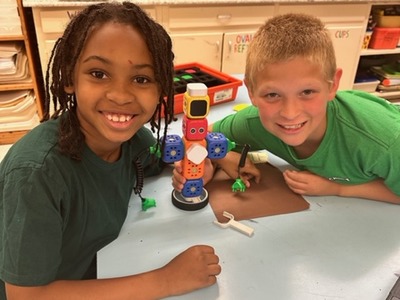
Launching a K–5 STEM Program: A Step-by-Step Guide
Presented by Justin Artis, Technology Teacher, Wisdom Primary School, Uplift Education (TX); and Deann Poleon, Educational Technology Integrator, Lake Shore Central School District (NY)
Moderated by Matthew Bannon, Experienced Educator, Head of Product and Learning Design, Robo Wunderkind
Sponsored by Robo Wunderkind
Learn more about earning a CE certificate and our accessibility features.
You have a STEM room, a schedule, and maybe a budget, but no clear curriculum, few examples, and little time to plan. Many STEM teachers work this way, whether the program is brand new or a few years old and still feels like it’s starting over every fall. That includes librarians, media specialists, and classroom teachers who took on STEM without a STEM background.
This recorded edWebinar walks you through the key steps of launching or relaunching an elementary STEM program. See what to teach in each grade band and what students can realistically do by the end of the year. Learn how to set up routines, storage, and materials so 25 students can build, code, and clean up in a 40-minute class. Also, learn what to look for in STEM tools so that they work across grades, save you planning time, and keep students engaged, plus how to show your principal the program is working before budget decisions are made. The session is geared toward teachers who are new to their STEM program and anyone whose program still hasn’t found its footing.
You leave with:
- A one-page K–5 STEM scope-and-sequence template, organized by grade band (K–2 and 3–5)
- A launch plan for classroom routines, student roles, and materials that works at the start of any year or semester
- A checklist of key questions to ask before choosing STEM tools
- A “show-your-impact” tracker that connects STEM work to what students learn in other subjects
- A guide to common STEM funding sources, with questions to ask your principal
This recorded edWebinar will be of interest to K–5 STEM and STEAM teachers, computer science and technology teachers, library media specialists, instructional coaches, and elementary school and district leaders.

About the Presenters
Justin Artis is a Technology Teacher at Wisdom Primary School in Dallas, Texas, where he helps young learners develop essential digital literacy and technology skills. Through his work, Justin focuses on introducing students to technology in engaging, age-appropriate ways that encourage creativity, critical thinking, and problem solving. He recognizes the importance of building a strong foundation in digital learning during the early elementary years and supporting students as they develop the confidence and skills needed to navigate an increasingly technology-driven world.

Deann Poleon serves as an Educational Technology Integrator at Lake Shore Central School District (NY). Bringing 25 years of educational experience to her role, Deann works as a guide, thought partner, and advocate for interactive learning. She specializes in integrating coding, robotics, and emerging classroom technologies, helping K–12 educators build authentic, student-centered environments that foster creativity and critical thinking.

About the Moderator
Matthew Bannon has 19 years of experience in education as a K–5 teacher, administrator, curriculum developer, and consultant. Most recently, he taught in a project-based K–5 STEM program, planning hands-on lessons across grade levels and running them in real classrooms. His time as an administrator gives him the school leader’s view of what makes a STEM program worth keeping. He has worked in Title I public, charter, and private schools, and he believes every student should start building technology skills in elementary school. Today, he leads the Product and Curriculum teams at Robo Wunderkind, where he designs K–5 STEM, coding, and AI literacy lessons that teachers can use right away, with or without a STEM background.
Join the STEM Learning community to network with educators, participate in online discussions, receive invitations to upcoming edWebinars, and view recordings of previous programs to earn CE certificates.
Learn more about earning a CE certificate and our accessibility features.

An AI-driven world requires new skills: curiosity, creativity, problem solving, and computational thinking. Robo Wunderkind helps students build them from elementary school. Our PK–5 STEAM program brings hands-on robotics, coding, and AI literacy into the classroom, even when the teacher is new to STEM. One set of modular robots and one block-based coding app work across every grade, and ready-to-teach lessons in the STEAM Hub connect to other subjects, so teachers can start in less than a day. Onboarding, professional development, and ongoing support help schools roll out the program and keep it going when staff changes. Since launching in the U.S. in 2022, Robo Wunderkind has grown to more than 200 schools and 50,000 students, was named Best STEM Solution in the 2025 EdTech Awards, and aligns with ISTE and CSTA standards.