

Augmented Reality, or AR, is described by Jaime Donally in a recent edWebinar as a “digital layer in our real world that gives an illusion that it exists in our space.” She highlights that it is an exciting time, as emerging technologies associated with AR are feeling much more realistic. AR software such as Google Maps allows the viewer to have guidance as they are walking in a new area, and AR embedded browsers can display 3D animated objects in real-life environments. The key to giving students opportunities to engage in augmented reality begins with supporting teachers as they enhance learning experiences for students. Using AR software and tools such as 3DBear and MERGE, teachers have access to an abundance of activities and lesson plans that offer more in-depth content, provide opportunities for collaboration and exploration, and expand students learning experiences outside of classroom walls.

In this edWebinar, Jaime Donally, author, speaker, and consultant, will review the basics of AR, while exploring four lesson plans to use in any classroom.
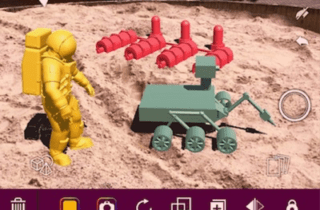
For teachers that have always wanted to use augmented reality (AR)—tech that overlays content on top of the real world—but haven’t had the chance to explore it, Jaime Donally has heard you. In her presentation “Creating Classroom Content in Augmented Reality,” she gave attendees some inside help on which apps to use in the classroom. With programs ranging from beginner level to current AR practitioners, she offered 10 apps that can help educators get started with no coding skills needed.
In this edWebinar, gain an understanding of the AR technology and knowledge about how to effectively use the tool in the classroom curriculum.

Augmented reality, virtual reality, mixed reality—can immersive technology really benefit students and their learning, or are these just tech fads? In their recent edWebinar, Jaime Donally, Author, Speaker, and Edtech Consultant, and Michelle Luhtala, Library Department Chair at New Canaan High School in Connecticut, explained that although these technologies aren’t the answer to everything, they are transforming learning and will continue to do so going forward. In addition, while the thought of using these tools can be exciting, schools need to first plan for successful integration into the classroom and curriculum.
In this edWebinar, Michelle Luhtala and guest Jaime Donally, discuss how to integrate augmented, virtual and mixed reality into any classroom.

Augmented reality is emerging in the education space as a tool for motivating children to learn. Using this 3D technology can help students significantly whether they’re struggling to learn reading or math, or just to engage. Cynthia B. Kaye, CEO and Chief Zoo Keeper at Alive Studios, discovered this technology while in search of a way to support her own two ELL children. She discussed the benefits of using augmented reality in the classroom in “Engaging Early Learners with Augmented Reality.”

In this edWebinar, see mind-boggling 3D technology used to engage and excite young learners. Augmented reality is emerging in the education space as a tool.
In this webinar for the edWeb.net How Video Empowers Education community, presenter Shannon McClintock Miller, District Teacher Librarian and Technology Integrationist, showed how she integrates video into her library and school using digital tools, creative projects, and global connections. She shared how her students are creating and sharing eBookTalks, using augmented reality and QR codes to make interactive activities and displays of their book covers and book reviews.

As Drew and Brad say, “We do not like presentations that talk about 100 great apps because teachers do not have time to get to #13 much less #100. We focus on 2 apps and augmented reality. We use these 2 apps each week and it has changed the game for us as educators.”