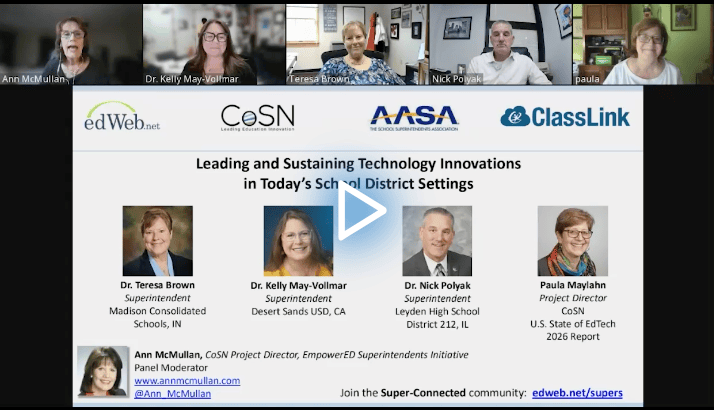
This edLeader Panel is presented by CoSN and AASA.
Sponsored by ClassLink
District leaders constantly take stock of their districts' technology landscape—what’s working, what’s not, and what’s next. But as superintendents noted during the edLeader Panel "Leading and Sustaining Technology Innovations in Today’s School District Settings," the scope of that is overwhelming. That’s why they shouldn’t do it alone. Based on key findings from CoSN’s U.S. State of EdTech 2026 report, the panelists offered their strategies for managing the ever-changing edtech landscape.
Cybersecurity
While at the time of the report, this was the number one concern, the majority of respondents said they didn’t have sufficient staffing to handle it. In addition, all panelists agreed that the insurance—and the requirements to obtain insurance—have become prohibitive for many. Moreover, hackers have become more brazen, using AI to hack en masse.
Beyond firewalls and filters, the superintendents highlighted education and training as their number one priority. This includes not only the typical phishing safety seminars, but also educating the community about what the technology staff does. Help them understand the goals surrounding cybersecurity and how they can partner with the tech department. One superintendent suggested recognizing teachers and staff who spot attempted issues. Also, encourage students to learn more about cybersecurity. Students at Leyden High School District 212 (IL) can choose a cybersecurity pathway, giving them in-demand skills when they graduate and making them part of the solution in the building as well.
AI
The panelists theorized that this will be the biggest concern in 2027 because there is so much that schools don’t know yet. What superintendents are looking for, though, is guidelines, not mandates. They want the space to figure out what works in their school community while having guardrails to make sure they keep learning human centered.
Of course, any AI tools must follow district guidelines, especially regarding data privacy. But while many schools have integrated AI into overall building operations, there are still questions about using it in the classroom. At Desert Sands Unified School District (CA), they have AI coaches who help teachers and have created an AI toolkit that builds lessons around real-life scenarios. Based on the philosophy RISE (Respect, Integrity, Support, Empathy), the goal is to help students analyze when they should and shouldn’t use AI, how they should use it, and its impact on their work.
Procurement
Technology apps used to be the Wild West in education, with teachers and staff downloading whatever they wanted to try or thought they needed. With student privacy protection laws and cybersecurity risks, that shouldn’t happen anymore. All of the panelists reported an intense vetting process for acquiring new tools. In addition, IT monitors the systems to make sure no one is using rogue applications as well as redirecting them to what’s available.
Similar to educating the staff about the role of the IT department, another solution is to bring the academic and the tech staff together to examine requests. At Madison Consolidated Schools (IN), a committee of teachers, IT, and administrators regularly reviews teacher requests. The administration started the committee because there were so many requests, and the individual departments didn’t feel comfortable saying yes or no. Now, they can take a deeper dive into all requests and look at the program from all angles.
Teaching and Learning with Technology
Starting with COVID, many communities were pushing for one-to-one tech. Now, there are concerns over screen time mixed with the realities of the lack of home internet access and support staff impacting these initiatives. Moreover, many families don’t understand the difference between consumer and educational screen time.
Since schools are preparing students for future jobs where tech is ubiquitous, the best strategy is to show the community how the technology is integrated with learning goals. This means that technology coaches and subject-matter experts should work together to build projects into the curriculum that provide meaningful interactions with technology and show how it supports their learning.
Finally, the panelists discussed the increasing impact of politics on edtech and why superintendents need to keep an eye on legislation that will affect education in the short and long term. Many times, laws and regulations are being discussed without legislators understanding their true impact on schools. Superintendents need to be civic leaders as well as education leaders to ensure that their students get the best education possible.
Learn more about this edWeb broadcast, Leading and Sustaining Technology Innovations in Today’s School District Settings, presented by CoSN and AASA and sponsored by ClassLink.
Join the Community
Super-Connected is a free professional learning community for school superintendents, district leadership, and aspiring district leaders.
 AASA is the premier association for school system leaders and serves as the national voice for public education and district leadership on Capitol Hill.
 CoSN (the Consortium for School Networking) is the premier professional association for school system technology leaders. CoSN provides thought leadership resources, community, best practices and advocacy tools to help leaders succeed in the digital transformation. CoSN represents over 13 million students in school districts nationwide and continues to grow as a powerful and influential voice in K-12 education.

ClassLink is the identity and access management platform trusted by over 25 million students and staff in more than 3,000 school systems worldwide. ClassLink simplifies access with single sign-on, automates provisioning and rostering, and strengthens security and governance across the school system. With analytics that connect edtech usage to student outcomes, ClassLink helps education leaders manage technology with confidence and invest in what works. Learn more at classlink.com.

Article by Stacey Pusey, based on this edLeader Panel